I’ll be honest with you — the phrase personal data collection should immediately make you slow down when you see it in a privacy policy.
I’m not saying it’s always bad. But I am saying it’s usually broader than people think, and sometimes deliberately so.
In this post, I want to explain personal data collection, how data collection actually works in the real world, and why companies love using vague language when talking about your personal data.
This article is part of our Privacy Policy Guide, which breaks down how different privacy policy clauses affect user data across platforms.
Table of Contents
What Personal Data Collection Means in Privacy Policies
When a company says it collects personal data, they’re not talking about just your name or email.
They’re talking about anything that can be tied back to you, now or later.
And here’s the uncomfortable part:
privacy policies are written to stay useful for the company, not to be clear for you.
That’s why they avoid specifics. Broad wording gives them room to expand data collection without rewriting the policy every time they add a feature.
I’ve seen this pattern over and over again.
Common Terms Used to Describe Personal Data
If you’ve ever skimmed a privacy policy, you’ve probably seen these terms used to describe personal data collection:
- Personal data / personal information – a broad label for any information that can directly or indirectly identify a user.
- Identifiers – data points that allow a service to recognize and distinguish one user from another.
- Account information – details associated with a user account, often covering more data than just login credentials.
- Registration details – information provided during signup that is typically retained as part of the user record.
- Name, email address, phone number, username – direct identifiers that allow all other activity to be linked back to a specific person.
Different words, same result: the system can identify you and connect your activity over time.
How Personal Data Is Collected
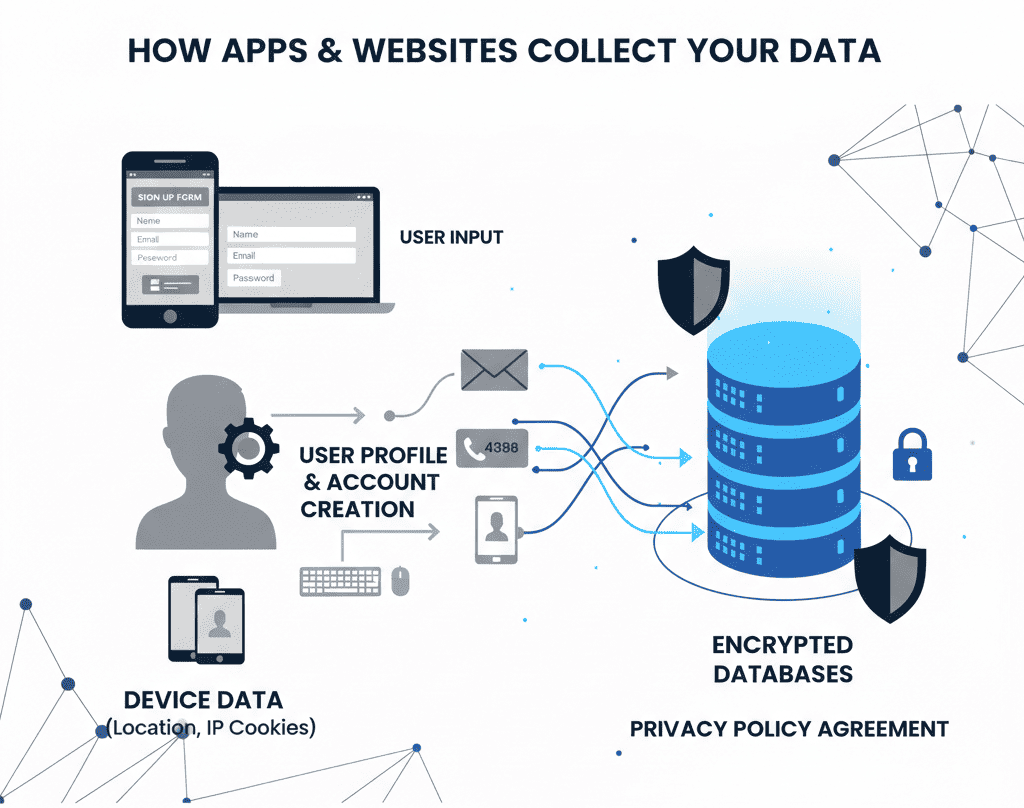
Most data collection doesn’t feel invasive. That’s the problem.
From what I’ve seen, personal data is collected through:
- signup forms
- profile edits
- everyday app usage
- support chats and emails
You don’t feel watched.
You just feel “logged in.”
But behind the scenes, data keeps stacking up.
How Companies Use Personal Data (Beyond the Obvious)
Yes, personal data is used to:
- create accounts
- verify identity
- send notifications
- keep services running
That’s the part everyone accepts.
What people don’t think about is reuse.
The same personal data can later be used for:
- analytics
- personalization
- advertising
- “business purposes” (a favorite vague phrase)
And once data exists, companies rarely want to delete it completely.
The Part That Actually Worries Me
The real risk isn’t one piece of data.
It’s accumulation.
Over time, personal data collection allows companies to:
- connect actions across sessions
- combine identifiers
- build long-term profiles
An email address alone isn’t scary.
An email tied to behavior, preferences, location, and usage history is a different story.
That’s when data stops being “information” and starts becoming a record of you.
User Control Over Personal Data
Most privacy policies say you can control your data.
And technically, yes — you can:
- edit your profile
- request deletion
- close your account
But almost every policy also includes exceptions.
Data may be retained for:
- legal reasons
- security reasons
- operational reasons
Those words are intentionally broad.
So while you may stop using a service, parts of your personal data often stay behind.
How We Flag Personal Data Collection in Our Analyzer
When our Privacy Policy Analyzer flags personal data collection, it’s not guessing.
It’s detecting language that signals:
“This service can link information back to a real person.”
Different wording doesn’t change the reality.
It just changes how easy it is to notice.
When Personal Data Collection Is Normal — and When It’s Not
Here’s my honest take.
Some level of personal data collection is normal.
Accounts don’t work without it.
But it becomes concerning when:
- the policy keeps definitions vague
- collection is described as “necessary for business purposes”
- data use can expand without clear limits
That doesn’t mean misuse is guaranteed.
It does mean the company has options — and you don’t always see them.
What Personal Data Collection Usually Includes
In most privacy policies, personal data collection typically includes:
- contact details such as email addresses and phone numbers
- account identifiers like usernames or IDs
- information provided during registration
- data linked to account activity over time
Even when policies do not list every data point, broad definitions allow companies to include new forms of personal data without updating the language.
Final Thoughts (My Opinion)
Personal data collection isn’t evil.
But blind trust is dangerous.
Once your personal data is collected, you lose leverage. The company gains flexibility. And most users never notice until something feels wrong.
Understanding data collection doesn’t make you paranoid.
It makes you informed.
And honestly, that’s the minimum we should expect.



Pingback: Device and Technical Data Tracking Explained in Privacy Policies
Pingback: What Location Tracking in Privacy Policies Really Means - Pixel Defence
Pingback: Best Free VPNs With No Ads – The Unfiltered Reality (2026) - Pixel Defence