The Massive WhatsApp Metadata Leak: Why Encryption Won’t Save You (2025)
You see the “End-to-End Encrypted” lock icon every time you open a chat, so you assume you are safe. However, the 2025 WhatsApp Metadata Leak proves you might be mistaken.
While the content of your messages remains locked, the metadata—the “digital envelope” that reveals who you are and when you are active—is wide open. In late 2025, researchers from the University of Vienna shattered the illusion of privacy. They exploited a “Contact Discovery” loophole to harvest metadata associated with up to 3.5 billion WhatsApp account identifiers.
This isn’t a hack; it’s a feature. Furthermore, it acts as the primary engine behind the Meta Shadow Profile you didn’t know you had.
How Researchers Exposed the WhatsApp Metadata Leak
In November 2025, a team of security researchers led by Gabriel Gegenhuber (University of Vienna & SBA Research) revealed a major flaw in WhatsApp’s “Contact Discovery” API. By using a reverse-engineered script, the team successfully queried 100 million phone numbers per hour without Meta’s servers blocking them.
Consequently, the study revealed alarming data:
- Global Enumeration: The researchers confirmed the existence of billions of active accounts across 245 countries.
- Profile Data: They scraped “About” text, profile pictures, and online status timestamps.
- The “Shadow” Link: This data allows trackers to link your “secure” WhatsApp number to your unlisted Facebook profile. This feeds the surveillance machine we exposed in our Meta Spying Report.
Tech Exposed: The study, titled “Hey there! You are using WhatsApp,” highlighted a critical privacy failure. Even if you block a contact, your “About” text often remains visible to the API.
While Meta’s data harvesting is well-documented, the ‘Meta Trap’ often hides in the fine print of their ever-changing legal terms. To see exactly how these updates impact your current rights, you can use our AI Privacy Policy Analyzer. By pasting their latest policy into the auditor, you can instantly see if Meta has added new clauses regarding biometric data or off-platform tracking that weren’t there during your last review.
The Zero-Click Threat and the WhatsApp Metadata Leak
If the scraping wasn’t bad enough, 2025 also brought us a new Zero-Click vulnerability.
Security teams tracked this as CVE-2025-55177. This flaw in WhatsApp for iOS allowed attackers to compromise a device simply by sending a specifically crafted image file. You didn’t even have to click it. The moment your phone processed the image preview, the malicious code executed.
Although Meta has patched this specific hole, it proves a critical point: An encrypted app running on a compromised OS is not private.
The Meta AI Trap: Your Chats Are Training Data
As of late 2025, Meta has integrated its AI assistant directly into WhatsApp. While your personal chats remain encrypted, any interaction with the Meta AI bot is not end-to-end encrypted.
Meta’s own privacy policy admits that the system uses these chats to “improve AI models.” Therefore, if you ask the AI for medical advice or financial tips, Meta harvests that data. They likely use it to improve ad targeting systems across Instagram and Facebook.
Mitigation Strategies: Protecting Yourself from a WhatsApp Metadata Leak
You cannot turn off metadata collection completely. However, you can significantly reduce your exposure to a future WhatsApp Metadata Leak.
1. The “Contact Sync” Purge The Vienna leak worked because millions of people sync their contacts.
- Go to: Settings > Privacy > Contacts.
- Action: Deny WhatsApp access to your contact list.
- Why: If you don’t feed them the data, they cannot map your social graph.
2. Lock Down Your Profile Don’t let scrapers see your face.
- Go to: Settings > Privacy > Profile Photo.
- Action: Set to “My Contacts Except…” or “Nobody.”
3. The Ultimate Defense: Leave the Ecosystem If you need true anonymity, you must move to an app that doesn’t collect metadata.
- Signal: Collects only your phone number and last login date.
- Threema/SimpleX: Doesn’t even require a phone number.
Conclusion: The Encryption Illusion
WhatsApp is a secure delivery truck driven by a surveillance company. The lock on the back door works, but the driver (Meta) is writing down every address you visit.
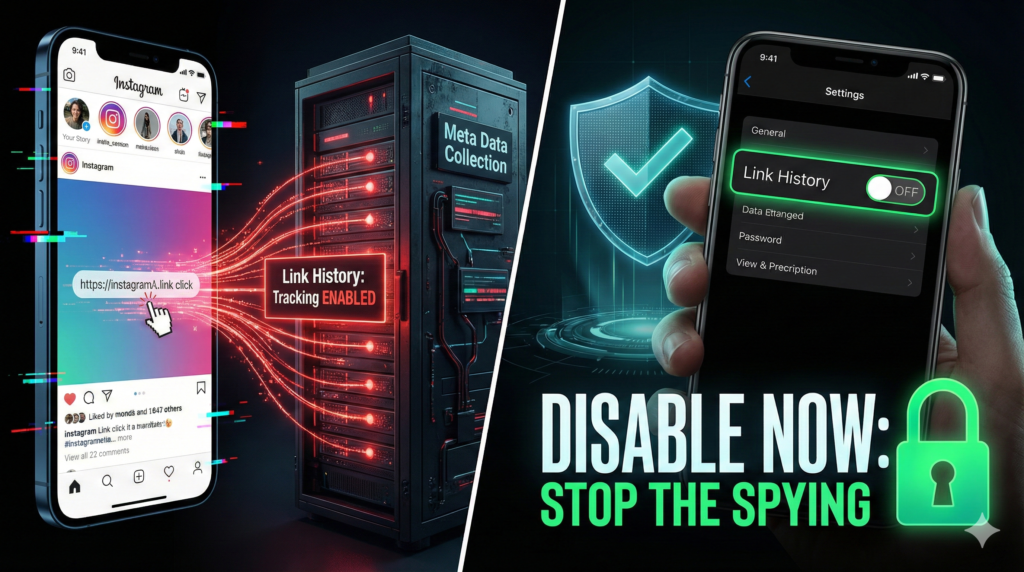
To truly secure your digital life, you must look beyond the app. Start by auditing your browser security with our guide on Instagram Link History.
Was your data exposed? Don’t wait for the hackers to act. We have built a step-by-step protocol to lock down your finances and logins. 👉 [Start the PixelDefence Protocol Now]
Stay privacy-aware.



Pingback: Stop Facebook Tracking: How Meta Spies Offline & How to Block It