Imagine walking into a kitchen, pouring a fresh glass of water, and turning on every light bulb in your house. Now imagine doing that every single time you type a simple, five-word prompt into a chatbot.
It sounds like an exaggeration. But behind the clean, minimalist interfaces of Google Gemini, ChatGPT, and Claude lies an unprecedented physical footprint: the AI environmental cost is starting to break the physical grid.
Every time you ask a “free” AI to summarize an email or generate an image, a windowless concrete warehouse in Iowa or Virginia draws massive current from the local electrical grid and evacuates hundreds of gallons of water to cool its processors.
I’m Rock, the founder of Pixel Defence. I started this site to expose how Big Tech harvests your data and to give you the tools to fight back.
Usually, I write about the digital costs of technology—like how consumer data is silently mined to train models. But today, I want to talk about the physical bill.
The tech industry has spent the last two years convincing us that generative AI is a frictionless, cloud-based miracle.
What they aren’t telling you is that the physical grid is buckling under the weight of your prompts, and local communities are paying the price.
Through my research, I have uncovered three hidden grid demands that Big Tech is desperate to keep out of the headlines.
It’s time to look past the marketing greenwashing and see what this technology actually costs the planet.
How much power does artificial intelligence use?
To understand the scale of the energy crisis, we have to look at the computational brute force required to make AI “smart.” In the early days of search engines, a query required a fraction of a second on a basic server.
Generative AI is different. It doesn’t just retrieve information; it reasons, calculates probabilities, and generates new tokens from scratch.
According to empirical research from Epoch AI, the cost of training frontier AI models has grown by a factor of 2.4x to 2.6x per year since 2016. A massive portion of this cost is physical power. To put this in perspective:
- The Gemini Ultra Training Run: Training Google’s flagship Gemini Ultra model required an estimated 35 megawatts of electrical power capacity. That is enough energy to power a medium-sized town for the duration of the training.
- The Grid Explosion: The International Energy Agency (IEA) estimates that US datacenter electricity demand will more than triple by 2035, growing from 200 terawatt-hours to 640 terawatt-hours per year.
- Gigawatt-Scale Future: If current trends continue, Epoch AI projects that AI supercomputers will require gigawatt-scale power supplies by 2029. That is the output of a standard nuclear power plant dedicated entirely to a single AI system.
This exponential growth is why tech companies are desperately locking down long-term energy contracts.
Microsoft recently signed a massive agreement for 7.9 gigawatts of new electricity generation in the MISO market just to keep up with its projected AI capacity.
Meta, not to be outdone, raised its midpoint capital expenditure forecast for 2025 to a staggering $68 billion, with a massive chunk of that capital going directly into securing power access and datacenter hardware.
We are no longer talking about servers in a basement. We are talking about industrial energy hogs that draw power directly from high-voltage transmission lines, often outcompeting local manufacturing and residential grids.
Why do AI datacenters need so much water?
Electricity isn’t the only physical resource AI consumes. Thousands of high-performance graphic processing units (GPUs) packed into server racks generate intense heat.
If these chips overheat, they slow down or fail. To keep them running at peak efficiency, datacenters must evaporate millions of gallons of water every day.
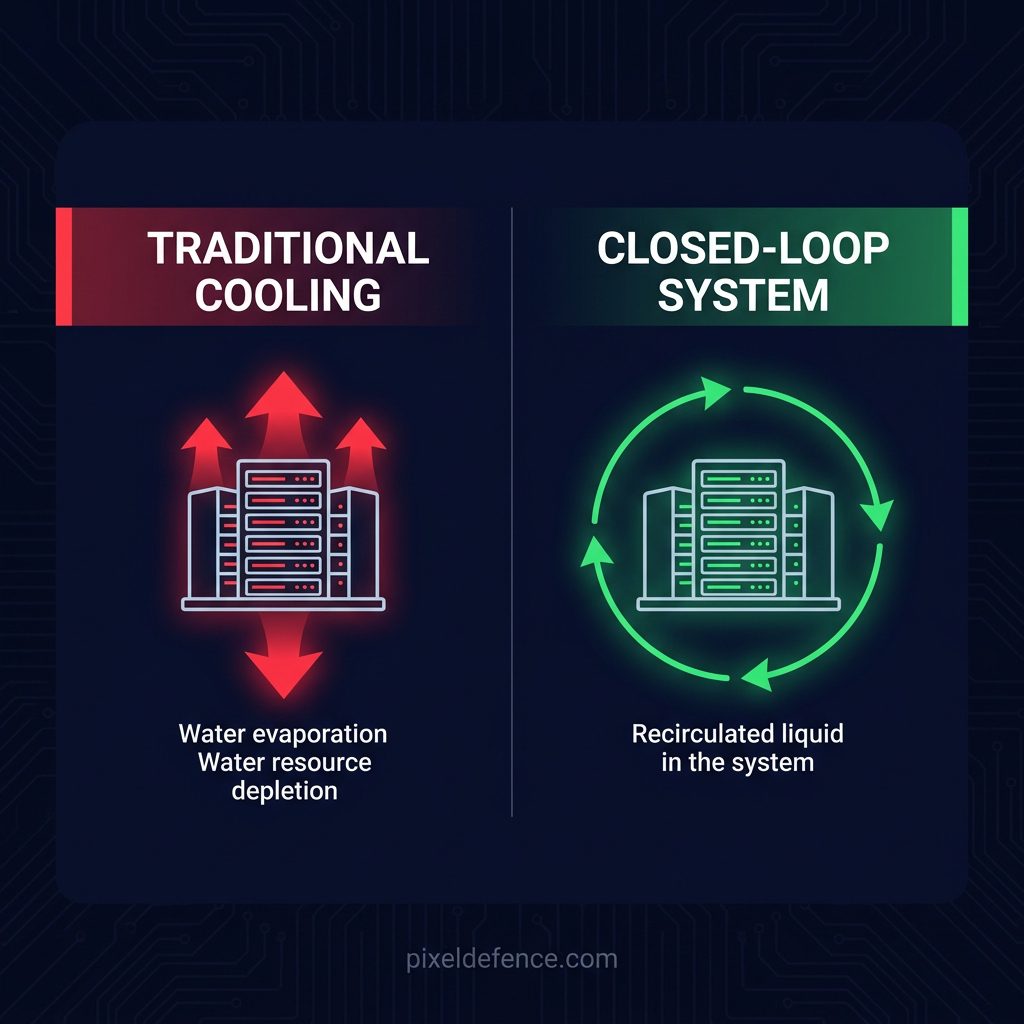
Historically, datacenters used evaporative cooling systems. These systems pull in water, run it along the hot servers, and let it evaporate into the air to carry the heat away.
In arid cities or agricultural regions already struggling with droughts, this consumption is a direct threat to local aquifers.
Tech companies are quick to release sustainability reports with grand promises. Microsoft, for instance, has set a goal to improve its datacenter water-use intensity by 40% by 2030, promising to “replenish more water than we withdraw.”
But corporate environmental accounting is highly subjective. Investing in wetland restoration in one state does not directly replenish the water table in a dry Arizona suburb where an active datacenter is operating.
Microsoft has also claimed to launch a next-generation AI datacenter design that uses a “closed-loop system” where liquid is constantly recirculated, claiming that “potable water is no longer needed for cooling.”
While this is a step forward, the vast majority of active datacenters globally still rely on standard water-evaporation cooling. When you look at their terms of service using our Privacy Policy Analyzer, you won’t find a single paragraph detailing the true AI environmental cost of the servers processing your data.
The physical environmental costs are kept completely separate from the digital terms you agree to.
What is the carbon footprint of training AI models?
When we talk about the AI environmental cost, we have to look at the lifecycle of training. The development of a frontier model is split into three main resource demands: hardware procurement (47–67%), R&D personnel (29–49%), and direct electricity/energy (2–6%).
While the direct energy of a single training run seems like a small percentage of the financial cost, the cumulative carbon footprint of the hardware supply chain is immense.
GPUs are made of rare earth minerals that must be mined, refined, and shipped globally.
Because these chips become obsolete every 18 to 24 months as models advance, the physical hardware lifecycle creates a continuous loop of carbon emissions and electronic waste that is completely ignored in standard sustainability disclosures.
If these models are so resource-intensive to build and run, why are companies offering them for free?
The answer lies in market dominance. Tech companies are running these models at a loss to hook consumers and establish their platforms as the default standard. Meta’s open-source strategy is a prime example.
They spend billions on infrastructure and then release Llama models for free because it allows a global community to improve their code and cement Meta as the foundation of the AI ecosystem. They crowdsource their R&D and build dependency.
And for the free consumer tools that aren’t open-source? You pay with your data. Google, Microsoft, and Anthropic actively harvest consumer chats, files, and voice recordings to train the next generation of models.
They use your digital life to feed the very machines that are draining the physical grid. It is a closed loop of data harvesting and energy drain.
Who pays for the electricity cost of AI?
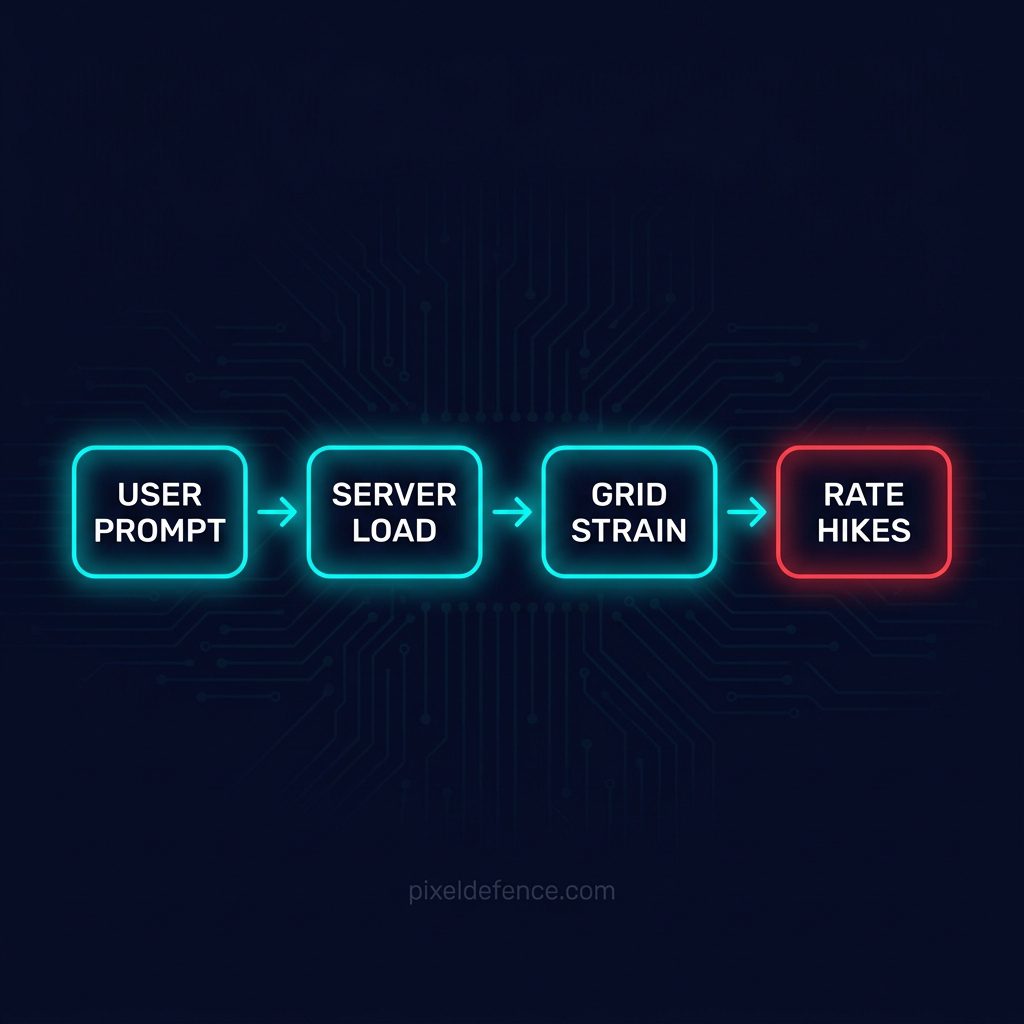
As datacenters monopolize local power grids, utility companies must build new power plants, lay high-voltage transmission lines, and upgrade substation infrastructure to handle the load. These upgrades cost billions of dollars.
Who gets the bill?
In many regions, utility companies are passing these grid infrastructure costs onto residential taxpayers through rate hikes.
Tech companies get tax breaks and subsidized energy rates to build their datacenters, while local residents see their monthly utility bills spike to pay for the upgraded grid.
Even corporate leaders are beginning to admit this is a political time bomb. Brad Smith, Vice Chair & President of Microsoft, publicly stated:
“we believe that it’s both unfair and politically unrealistic for our industry to ask the public to shoulder added electricity costs for AI.”
Despite this statement, the reality on the ground is that utility boards across the US are already approving rate increases to fund grid expansion for datacenters. Furthermore, the physical buildout is facing a massive labor bottleneck.
Microsoft reports an estimated national shortage of 439,000 skilled construction workers—specifically electricians, pipefitters, and heavy equipment operators—needed to construct these datacenters and build the electrical infrastructure.
We are actively diverting human labor away from building homes, schools, and public transport to lay copper cables for AI servers.
How can we reduce the AI environmental cost?
The tech industry wants you to believe that AI is a clean, virtual assistant. But as we’ve seen, every model we deploy has a physical footprint tied directly to grid strain, labor diversions, and water depletion.
If we want to stop this trajectory, we have to make different choices. We cannot rely on corporate greenwashing to solve the AI environmental cost.
Here is what you can do today to reduce the environmental and privacy costs of your AI usage:
- Stop using AI for trivial tasks. Before you ask a chatbot to write a two-sentence email reply, ask yourself if you need it. Running a frontier model for simple text completion is like driving a semi-truck to the grocery store to buy a carton of milk.
- Audit the privacy policies of the tools you use. Use our Privacy Policy Analyzer to scan the terms of the services you use. Look for companies that hoard your data for months or years. If a company keeps your logs forever, they are continuously running servers to store and process your history.
- Opt out of model training. If you must use tools like Copilot, Gemini, or Claude, turn off the settings that allow them to use your chats for model training. This directly reduces the computational load of retraining massive models on consumer datasets.
- Support local-first and lighter models. Instead of routing every query to a massive cloud datacenter, use smaller, specialized models that run locally on your own hardware. They use a fraction of the power and keep your data 100% private.
Big Tech is betting that you won’t look behind the screen. They want you to keep prompts flowing and data harvesting active. But now that you know the physical reality of the grid, you can choose to stop feeding the machine.
Sources
- Epoch AI — “How much does it cost to train frontier AI models?” (empirical data on training cost trends and 35MW Gemini Ultra requirements).
- International Energy Agency (IEA) — Electricity 2026 Report (datacenter energy projections).
- Microsoft — “Building Community-First AI: Infrastructure and the Labor Shortage” (439,000 construction worker shortage, Brad Smith quote, and closed-loop water systems).
- AI Sandbagging and Claude Mythos — Reference post on capabilities we don’t fully understand.
- AI Data Breach 2026 — Reference post on recent AI data breaches.