If you’ve ever wondered what not to type into ChatGPT, Gemini, or Claude — this is the article you didn’t know you needed.
Listen, we all do it. You’ve got a massive, chaotic spreadsheet you can’t be bothered to organize manually.
You have a weird, lingering rash on your arm that you don’t want to Google because WebMD will tell you it’s fatal.
Or maybe you’ve written a spicy, emotionally charged email to your boss that desperately needs a diplomatic rewrite before you get fired.
So you dump the whole mess in and hit enter. But do you actually know what not to type into ChatGPT — or any AI chatbot — before you do?
But wait. Have you ever actually stopped to wonder where all that text goes once you hit that button?
Here’s the unfiltered, slightly terrifying truth: these AI chatbots are not your private, locked diaries.
They are massive, data-guzzling machines designed to consume everything in their path. Unless you’ve actively dug through their complicated settings menus to explicitly opt-out of data sharing, your conversations are fair game.
Human reviewers—yes, real people sitting at desks—could be reading your deeply personal queries right now as part of their “Reinforcement Learning from Human Feedback” (RLHF) process.
Worse, your secrets might be used to train the next generation of the model. In the cybersecurity world, we call this a risk of “model inversion” or “data memorization,” where an AI spits out its exact training data to another user later down the line.
Your company’s financial secrets could literally become part of the AI’s permanent memory.
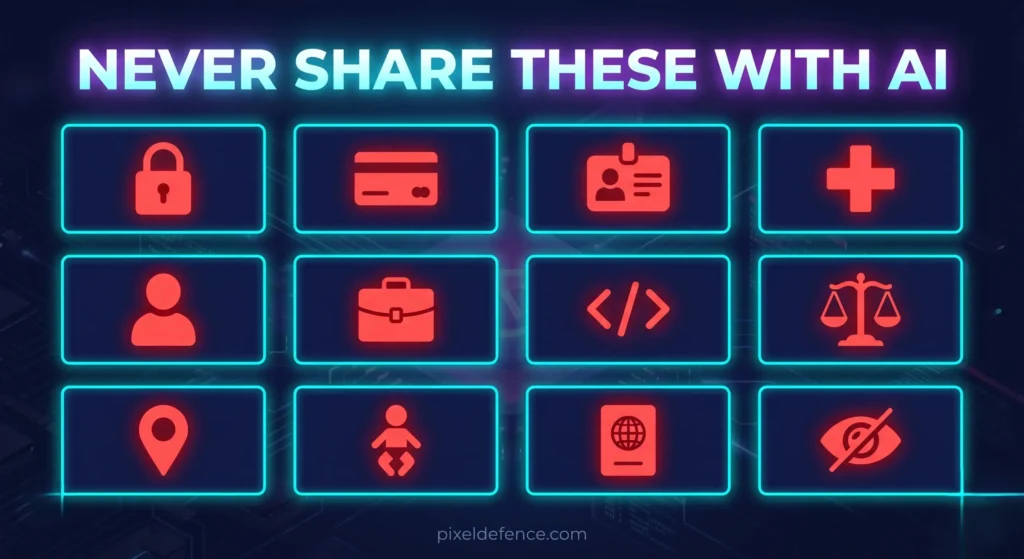
To make sure you aren’t accidentally serving up your life, your identity, and your security on a silver platter, Here’s the definitive list of what not to type into ChatGPT, Gemini, or Claude — and exactly why each one matters.
Table of Contents
1.Never Type Passwords or Login Credentials Into Chat GPT
Knowing what not to type into ChatGPT starts here — with the most basic rule of all This should be a completely obvious no-brainer, but it happens all the time—especially when people ask AI to generate code, troubleshoot a database connection, or debug a script.
Never, ever leave your actual password, API token, or database credential in the text box. Imagine handing the keys to your front door to a random stranger on the street just because they offered to hold your groceries.
That’s exactly what you’re doing here. If you need the AI to fix your code, replace the sensitive data with dummy text like “PASSWORD123” or “INSERT_KEY_HERE.” Once you hit send, you can never un-send that credential.
2. Financial Account Numbers
Whether it’s your personal credit card number, your bank routing details, or your cryptocurrency wallet seed phrase, keep it entirely out of the prompt box.
Sometimes people use AI to format invoices or sort out their monthly budgeting, carelessly pasting raw bank statements in the process.
If that data gets ingested, there’s a non-zero chance it could be regurgitated later, reviewed by a human annotator, or accessed during a server-side data breach.
You wouldn’t tape your credit card to a public billboard; don’t feed it to a language model.
3. Social Security or National ID Numbers
These numbers are the golden tickets for identity theft. An AI doesn’t need your actual Social Security Number to help you write a formal letter to the IRS, fill out a complex tax template, or dispute a credit report.
Treat your national ID number like a cursed, highly dangerous artifact—keep it locked away in a secure password manager and never let it see the digital light of day inside an AI prompt.
Identity thieves dream of finding datasets full of raw, unencrypted SSNs. Don’t do the work for them.
4. Your Medical History Is Not Safe in an AI Chatbot
Asking ChatGPT what that weird bump on your arm might be is incredibly tempting. It feels like having a doctor in your pocket.
But uploading your actual lab results, detailed medical history, or a list of specific medications you’re taking? Terrible idea.
Your health data is protected by strict laws (like HIPAA in the US) for a reason. AI companies aren’t your doctor, they are not your therapist, and they certainly don’t have doctor-patient confidentiality.
If the platform gets hacked, your private health struggles become public data.
If you wouldn't shout it through a megaphone in a crowded coffee shop, don't type it into an AI prompt.5. Other People’s Private Information
It’s one thing to risk your own data and deal with the consequences; it’s an entirely different thing to gamble with someone else’s privacy.
Don’t upload your friend’s resume to critique it if their phone number, email, and home address are still attached. Don’t ask the AI to summarize a private, highly sensitive email thread from your partner.
Respecting digital privacy means actively protecting the people in your orbit, too. Consent is key, and your friends definitely didn’t consent to being part of a training dataset.
6. Why You Should Never Share Work Secrets With AI
Thinking of asking Claude to summarize the Q3 financial forecast before your company announces it to the board?
In 2023, Samsung banned ChatGPT across their entire corporate network after employees leaked proprietary source code by asking the AI to check it for errors — a story that made global headlines This is a textbook example of what not to type into ChatGPT at work — and it cost Samsung dearly.
When you input trade secrets, client lists, or unreleased product roadmaps, you are effectively transferring corporate data to a third-party server without authorization.
Don’t be the reason your company makes headline news for a massive, embarrassing data leak.
7. API Keys and Code Secrets
If you’re a developer, an engineer, or just someone tinkering with some weekend code, it is terrifyingly easy to accidentally paste an active API key, SSH key, or OAuth token into an AI while asking for debugging help.
These keys are basically blank checks for your cloud accounts. If an AI ingests your AWS access key and it somehow leaks, you could wake up to a $50,000 server bill because a crypto-mining botnet got hold of it.
Always sanitize your code. Scrub every single secret before the prompt leaves your machine.
8. Sensitive Legal Information
Are you in the middle of a messy divorce, a complex lawsuit, or a high-stakes contract dispute?
Do not use an AI tool to review your unredacted legal documents. Attorney-client privilege is a sacred, legally binding shield that protects your communications.
The absolute moment you share those details with a third-party AI, you risk shattering that shield completely.
You are effectively waiving your right to confidentiality. Imagine handing opposing counsel your entire playbook just because you wanted a quick summary of a PDF.
"Convenience" is the easiest and most common way to trick smart people into doing incredibly risky things with their data.9. Your Precise Location and Daily Routine
“Hey Gemini, I run at 5 AM every morning around Miller Park, can you make me a hype playlist?”
Congratulations, you just gave away exactly where you are, what time you’re there, and the fact that you’re probably alone.
We often give up our location data in tiny, seemingly harmless chunks. We ask for restaurant recommendations near our highly specific address, or we talk about our daily commute.
But pieced together, this builds a perfect, highly accurate map of your life and routine for anyone who gets access to the server logs.
10. Information About Minors
If you wouldn’t post pictures or sensitive details of your kids on a public social media profile, you absolutely should not feed their personal details, school locations, or behavioral issues into an AI to get parenting advice.
“ChatGPT, my son attends Lincoln Elementary and is struggling with his ADHD, what should I do?” Children cannot consent to having their data ingested and analyzed by Big Tech corporations.
As adults, it is our responsibility to protect their digital footprint before they are old enough to understand what a digital footprint even is.
11. Your Immigration Status or Legal Vulnerabilities
If you are dealing with sensitive immigration processes, complicated visa applications, or any precarious, vulnerable legal status, keep those specifics firmly off the keyboard.
This kind of data can be incredibly weaponized if exposed to the wrong authorities or malicious actors.
It is totally fine to use the AI to understand general rules, read up on public policies, or translate official government documents, but never, ever feed it your exact case details, passport numbers, or undocumented status.
12. Intimate or Explicit Personal Content
Let’s keep it clean, folks. Using an AI chatbot as a digital therapist for your most intimate relationship issues, sexual health questions, or explicit personal desires is a privacy nightmare waiting to happen.
Remember those human reviewers we talked about earlier? The ones employed to rate and review conversations to make the AI safer?
You absolutely do not want them reading your late-night confessions on their lunch break. Keep your intimate life out of the cloud.
13. The Golden Rule of AI Privacy
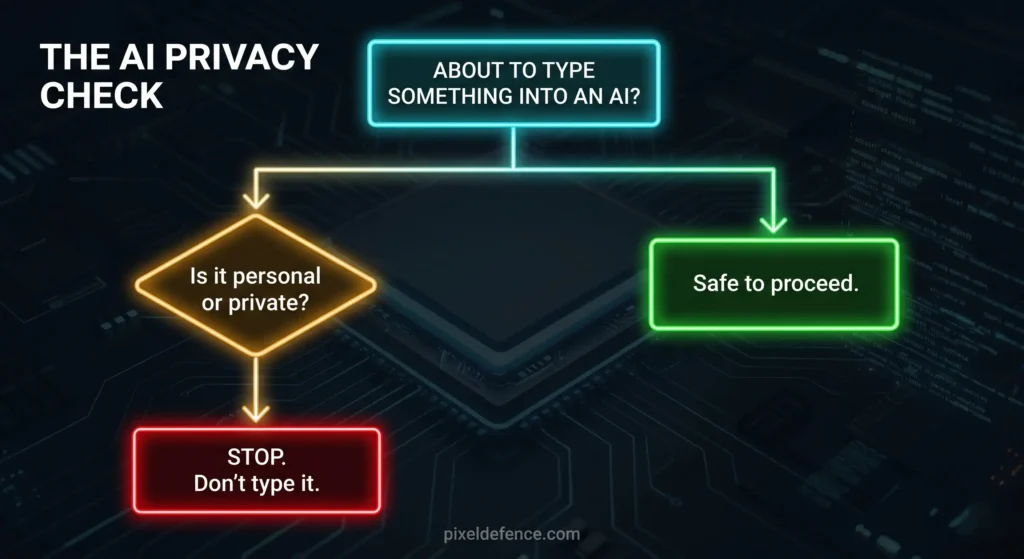
This is the ultimate, undeniable golden rule of the internet, and it applies tenfold to AI.
Before you hit that enter button, take a breath and ask yourself: “If this exact prompt was published on the front page of Reddit tomorrow, with my name attached to it, would it ruin my life?” If the answer is yes, hit the backspace key immediately.
The cloud is just someone else’s computer, and AI is just someone else’s algorithm. There is no such thing as perfect digital security.
You are the last line of defense for your own privacy. Do not outsource that vital job to a chatbot.The Bottom Line: How to Use AI Without Risking Your Privacy
Look, AI tools are incredible. I am not telling you to delete your accounts or throw your laptop in a lake.
Knowing what not to type into ChatGPT doesn’t mean avoiding AI altogether — I use these platforms every single day to outline ideas, write code, and brainstorm. But you absolutely have to treat them like a brilliant, highly capable intern who also happens to have a terrible habit of gossiping to the entire office.
Give them the context they need to do the job, but mercilessly redact the specifics. Use fake names, dummy numbers, generalized scenarios, and hypothetical situations.
If you need to fix a spreadsheet, change the names and the dollar amounts before you upload it. If you need code fixed, replace the keys with placeholders.
Still unsure about what not to type into ChatGPT when it comes to legal documents or work data? A good rule of thumb: if it’s sensitive in real life, it’s sensitive in the prompt box.
And if you’re ever curious about just how much data these companies are legally allowed to harvest from you, and what they do with it behind the scenes, you need to run their terms of service through our Privacy Policy Analyzer.
It takes ten seconds, runs entirely in your browser so it’s completely private, and it will tell you exactly what you’re really signing up for when you click “I Agree.”
If you’re looking for AI tools that don’t collect your data at all, we’ve put together a complete private AI tools directory rated by privacy score.
Now you know exactly what not to type into ChatGPT — stay smart, stay private, and keep your secrets to yourself.
What Not to Type Into ChatGPT: FAQs
Is ChatGPT safe to use?
ChatGPT is safe for general use, but it is not a private or confidential
platform. Conversations may be reviewed by human trainers and used to
improve the model unless you opt out in settings.
Does ChatGPT store your conversations?
By default, yes. OpenAI retains conversation history and may use it for
model training. You can disable this in Settings > Data Controls.
Can ChatGPT leak your personal information?
While rare, AI models can occasionally reproduce information from their
training data. The bigger risk is human reviewers, server breaches, or
accidental data sharing through prompts.
Is it safe to use Claude or Gemini instead?
All major AI chatbots — ChatGPT, Claude, and Gemini — have similar data
practices. None should be treated as a private or secure communication
channel.
Security Tip: While avoiding these prompts is crucial, you can also stop AI platforms from using your data entirely. Check out our step-by-step guide on how to opt out of AI training on every major platform.