
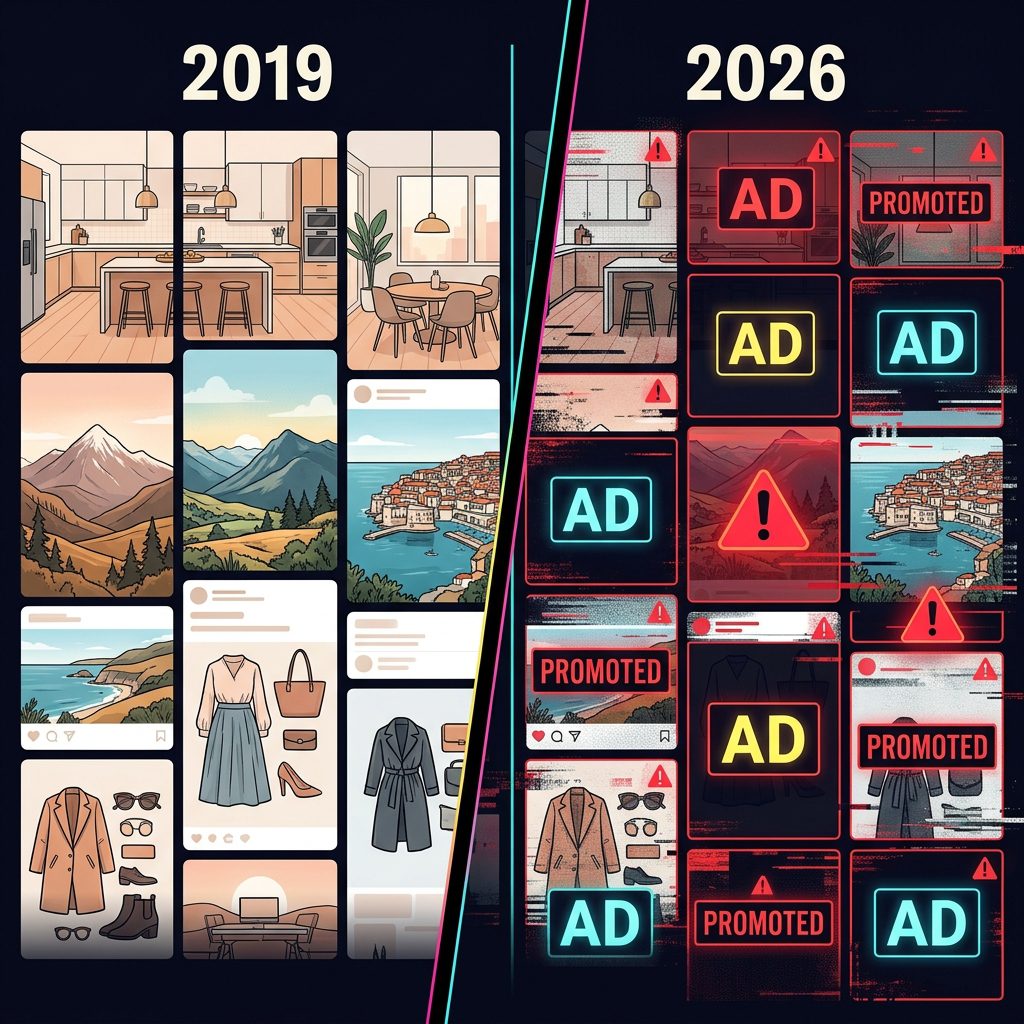
Pinterest used to be where I went to think.
Not to shop. Not to scroll. To think. To pull together ideas for a kitchen I wanted to renovate, a trip I was planning, a look I was building. It was a visual notebook that belonged to me.
Now I open it and I am immediately inside a shopping mall.
Every third row is a promoted pin. My search results load with ads before I can see a single piece of organic content. My home feed — the one supposedly built from boards I curated for years — feels like it was assembled by a retail store, not by me.
Something changed. I went looking for exactly what.
What I found is not a glitch. It is not an accident. It is a deliberate, carefully engineered shift in what Pinterest is — and what it has decided you are worth.
What Pinterest Used to Be vs What It Is Now
Pinterest launched as something genuinely different.
The pitch was simple and it worked: a digital corkboard. You saved images that inspired you. You organised them into boards. The algorithm learned your taste and showed you more of what you loved. It was quiet, personal, and useful in a way that felt almost anti-social-media.
The business model underneath it was always advertising. That part never changed.
What changed is who Pinterest decided it was advertising to.
For most of its early years, Pinterest sold advertisers on one thing: interest targeting. You pinned a lot of furniture images, so furniture brands could reach you. The logic was soft. Indirect. They were reaching you because you seemed to like a category of things.
That model has a ceiling. Interest is vague. Liking the idea of a mid-century sofa is very different from being about to buy one.
Pinterest figured this out around 2023 and spent the next two years rebuilding itself around a harder, more lucrative signal: purchase intent.
The company’s own investor communications now describe Pinterest not as an “inspiration platform” but as a “visual discovery engine” designed to shorten the path from discovery to purchase. The language shift is not cosmetic. It maps directly to what you experience every time you open the app.
By 2025, Pinterest had generated $4.222 billion in annual advertising revenue — a 16% increase year-over-year. That money does not come from brands reaching people who vaguely like interiors. It comes from brands reaching people who are about to buy interiors. [Source ]
To do that, Pinterest had to change what it was. And it did.
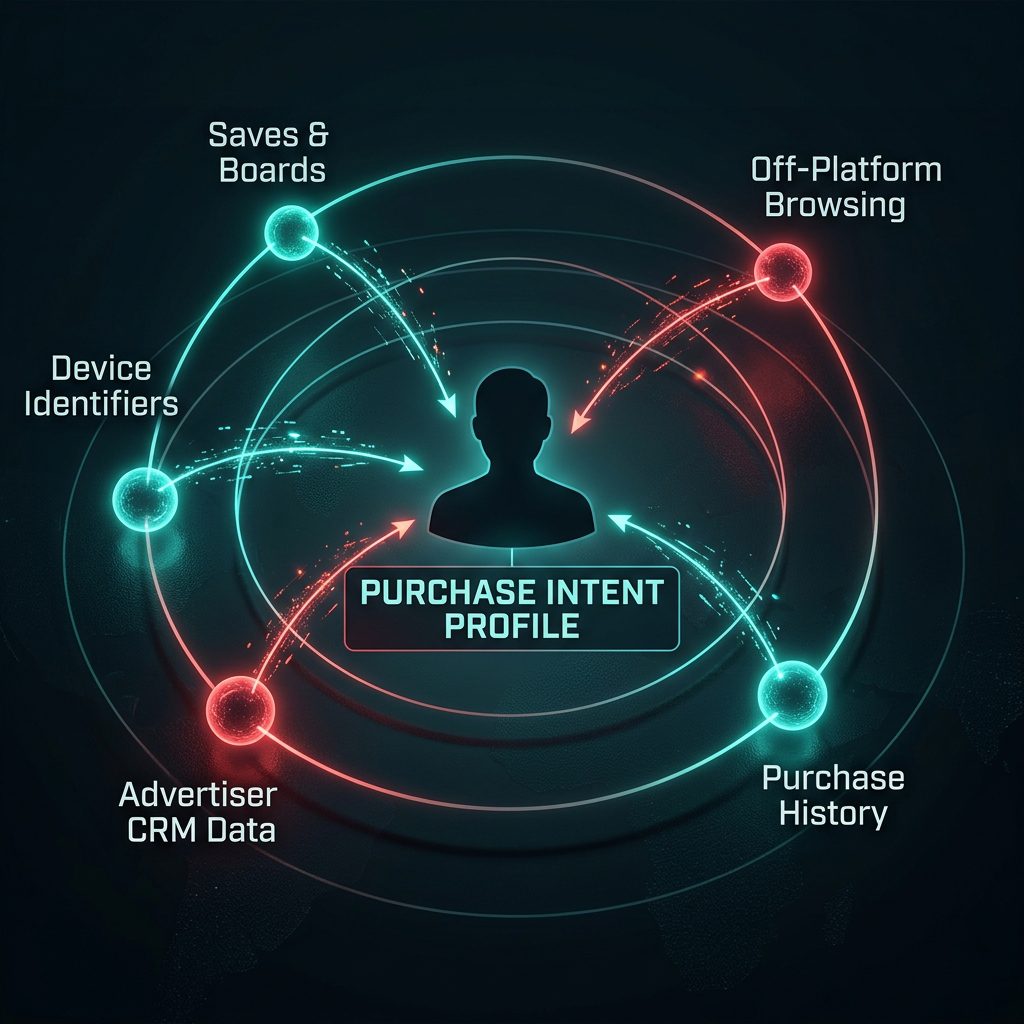
How Pinterest Builds Your Purchase Intent Profile
Here is the part most people do not realise.
When you save a pin to a board, you think you are organising your own ideas. You are. But you are also doing something else simultaneously: you are feeding a targeting system that tells advertisers exactly what you intend to buy and when.
Pinterest calls this its Unified Taste Graph.
Every action you take on the platform — every save, every click, every search query, every board you create — gets pulled into this system. The algorithm does not just log that you like kitchens. It logs the specific kitchen aesthetic you return to. The price range of the products you engage with. The frequency of your visits to kitchen-related content. The progression from casual browsing to focused, specific searches.
That progression is purchase intent. And it is extremely valuable.
But it does not stop at the platform edge.
Pinterest also tracks you off-platform through two mechanisms most users have never heard of.
The first is the Pinterest Save button — the little widget embedded on millions of third-party retail websites. Every time you visit a site that carries it, Pinterest receives a signal from your device. This happens whether you click the button or not. It happens whether you are logged into Pinterest or not. Your IP address, device identifiers, and browsing context are transmitted back to Pinterest’s servers.
The second is advertiser data sharing. When you visit a brand’s website, make a purchase, or take an action on a retailer’s page, that brand may share that data directly with Pinterest — via the Pinterest Tag or the Conversions API — to report on ad performance. Pinterest then uses that purchase data to sharpen your intent profile.
Run Pinterest’s privacy policy through our Privacy Policy Analyzer and you will see exactly how Pinterest phrases this in their own words. Buried in the legal language is an admission that they collect information about your “visits to an advertiser’s website” and “actions taken on those sites, such as purchases” from third-party partners.
Your inspiration board is not just a mood board anymore. It is a live, continuously updated commercial profile. And it connects directly into the full tracking system behind why ads follow you everywhere.
The Specific 2025–2026 Changes That Broke the Feed
The discomfort you feel when you open Pinterest today is not imaginary. It has a precise cause — and a precise timeline.
Here are the specific changes Pinterest made, and when.
Early 2025: The Purchase Intent Algorithm Shift
Pinterest retrained its core recommendation algorithm to weight purchase intent signals above interest signals. Previously, your board topics were the dominant input. Now the dominant input is behavioural inference — what the machine predicts you are ready to buy, based on your full activity pattern including off-platform data.
This single change fundamentally altered what the home feed is. It is no longer a reflection of your curated interests. It is a projection of what advertisers have paid to show someone with your profile.
Mid-2025: Performance+ and Automated Ad Expansion
Pinterest launched Performance+ — a suite of AI-powered tools that automates ad targeting, bidding, and creative optimisation for advertisers. The effect for users: ads became far more precisely targeted and far more numerous.
Performance+ allows advertisers to extend their reach beyond manually selected keywords. The system identifies users Pinterest’s algorithm flags as high-intent, regardless of whether that user explicitly searched for the product. In practice, this means ads now reach users earlier in their journey — at the passive browsing stage — not just when they are actively searching.
September 2025: Top of Search Ads
Pinterest launched Top of Search Ads — a format that places sponsored content within the first ten slots of every search result.
Pinterest’s own data shows 45% of user clicks on the platform happen within those first ten results. Monetising that space was inevitable. The result: when you search “boho living room” or “easy dinner recipes,” the first thing you see is not what people saved. It is what brands paid to put there.
Top of Search Ads achieve a 29% higher click-through rate than standard campaigns. That performance makes them irresistible to advertisers and guarantees they will keep expanding.
Source – https://business.pinterest.com/en/blog/top-of-search-ads
Ongoing: Actalike Audiences
This is the feature that quietly turns you into a targeting template for other users.
Pinterest’s Actalike Audiences allow advertisers to upload their customer list — hashed emails, purchase records, mobile ad IDs — and instruct Pinterest to find users who statistically resemble those customers. Pinterest cross-references the uploaded data against its Unified Taste Graph to identify matching profiles across its 619 million monthly active users.
The advertiser then reaches people they have never interacted with, based entirely on their resemblance to existing buyers. You do not have to have visited that brand’s website. You do not have to have searched for their product. Your profile — built from years of saves and searches — is close enough.
Pinterest reported ad impressions grew 41% year-over-year in Q4 2025. That number is the feed breaking. Every one of those additional impressions was an additional ad shown to a user. [SOURCE]
The compounding effect of all these changes — the intent-based algorithm, Performance+ automated expansion, Top of Search takeover, and Actalike audience scaling — is what you are experiencing every time you open the app. This is not ad density creeping up slowly. It is the result of simultaneous, coordinated changes that crossed a threshold most users felt in 2025 and into 2026.
Your feed followed you off Pinterest via the same retargeting system that makes ads follow you across every site — and now it is reaching you before you even leave the platform.
What You Can Actually Do
I want to be honest with you about what works and what does not.
You cannot turn Pinterest back into what it was in 2019. The business model has changed and the platform has been rebuilt around it. But you can reduce the signal you give them and shrink the profile they use to target you.
What works:
Restricting your Pinterest data settings directly cuts what Pinterest can share with advertisers. It does not eliminate ads — you will still see them — but it limits how precisely personalised they can be.
Using a browser-based version of Pinterest rather than the app gives you more control. Browsers support extensions that block tracking pixels, including the Pinterest Tag that fires on third-party websites.
Clearing your ad interests in Pinterest settings periodically forces the algorithm to rebuild your profile. During the reset period, targeting is less precise.
What does not work:
Marking ads as “not interested” has a negligible effect on volume. It may shift which advertisers reach you. It does not reduce how many ads appear.
Private boards do not prevent Pinterest from using your saves for targeting. The Taste Graph operates on all activity regardless of board visibility.
Logging out does not stop off-platform tracking. The Pinterest Save button tracks device-level identifiers that persist without a login session.
Your Pinterest Ad-Reduction Checklist
Five steps you can take right now:
- Restrict your ad data settings — Pinterest → Settings → Privacy and Data → Personalisation. Turn off “Use your activity on sites or apps you visit off Pinterest.” This cuts the off-platform signal used to build your intent profile.
- Clear your ad interest categories — In Privacy and Data → Ads Personalisation, review and clear the interest categories Pinterest has assigned to you. This degrades the precision of targeting.
- Block the Pinterest Tag off-platform — Install uBlock Origin or Privacy Badger. These block the tracking pixel on retail sites you visit, preventing the Pinterest Save button from reporting back.
- Run Pinterest’s privacy policy through Pixel Defence — Use the Privacy Policy Analyzer to see every data category Pinterest admits to collecting — in plain English, not legal text.
- Use Pinterest in browser, not the app — The app has broader device permission access. A browser session with an active content blocker gives you significantly more privacy than the native app on iOS or Android.
Pinterest is not broken by accident. It was rebuilt, deliberately, around a business model that treats your saved ideas as purchase signals and your profile as a commodity to be sold.
The inspiration board is still there. But underneath it, there is something else entirely.
Now you know exactly what it is.